Why battery storage matters for Oman
As solar and wind grow within Oman's power mix, the system needs more flexibility. Battery energy storage systems (BESS) can shift solar energy into the evening peak, provide fast frequency response, reduce curtailment and support grid stability in both the Main Interconnected System (MIS) and smaller networks.
Storage is no longer a niche add-on. It is becoming part of how utility-scale renewable, hybrid and industrial energy projects are designed from the start.
Techno-economic and revenue analysis
- Use-case definition: energy shifting, capacity, ancillary services, curtailment reduction
- Sizing of power (MW) and energy (MWh) to the use case
- Dispatch modelling alongside solar and wind profiles
- CAPEX, OPEX, augmentation and replacement cost modelling
- LCOS and project-level financial inputs
Battery technology due diligence
Battery chemistry, cell supplier, thermal management and fire-safety design all affect performance and risk — especially in Oman's high ambient temperatures. Technology diligence reviews cell and system specifications, degradation curves, warranties, performance guarantees, safety standards and the integrator's track record.
Hybrid system design and optimisation
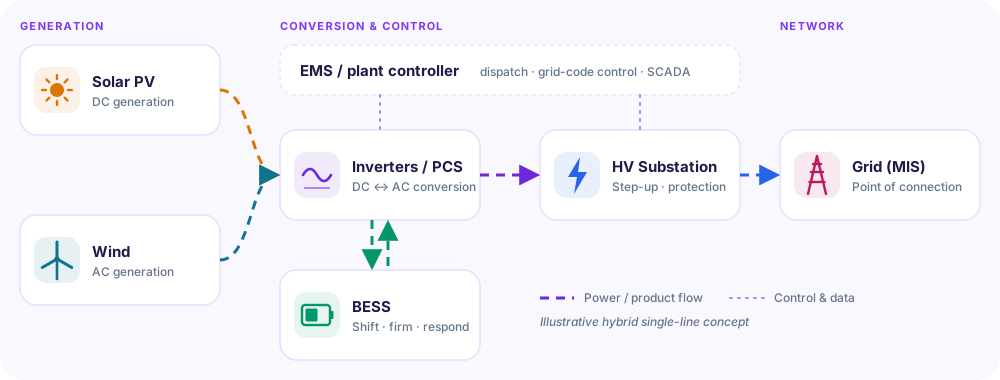
When storage is coupled with PV or wind, the design choices multiply: AC- or DC-coupling, inverter sizing, point-of-connection limits and control strategy. Optimising the hybrid system as a whole — rather than each component separately — typically delivers better economics and grid compliance.
Augmentation planning and lifecycle management
Batteries degrade. A bankable BESS project needs a clear augmentation strategy to maintain contracted capacity over the asset life, together with performance monitoring, availability tracking and warranty management during operations.
VESS experience
VESS has assessed utility-scale BESS with hybrid solar integration for a government asset, and integrates storage into feasibility studies for solar, wind and hybrid decarbonisation pathways.
Frequently asked questions
What size battery does a solar project need?
It depends on the use case. Energy shifting typically needs 2–4 hours of storage, while frequency response needs high power over shorter durations. Sizing should come from dispatch modelling rather than rules of thumb.
Does heat in Oman affect battery performance?
Yes. High ambient temperatures accelerate degradation and increase cooling loads, so thermal management design, degradation assumptions and warranties need careful review.
What is BESS augmentation?
Augmentation means adding battery capacity over time to offset degradation and maintain contracted energy capacity throughout the project life.